

The Forgotten Middle: Why Youth from Semi-Urban India Falls Through Every Policy

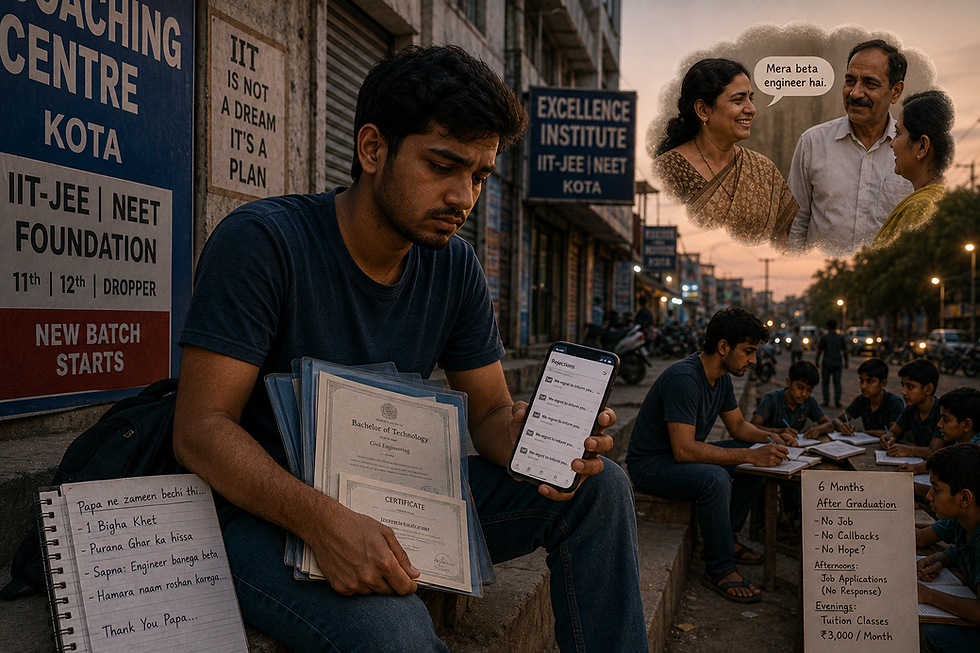
A 23-year-old boy sits outside a coaching centre in Kota with a folder full of certificates and a phone filled with rejection emails. His father sold a small piece of land so he could study engineering. His mother still tells neighbours with pride, “my son is an engineer.” But six months after graduation, he spends his afternoons applying for jobs that never call back and evenings teaching tuition to school children for ₹3,000 a month.
Travel a few hundred kilometers away to a small town in Uttar Pradesh, and you will meet a commerce graduate helping at her family’s grocery store because the nearest corporate office is hours away. In Bihar, a diploma holder prepares endlessly for government exams because private sector jobs barely exist around him. In Rajasthan, a bright young woman learns coding through YouTube videos because formal training centres are too expensive.
These are not isolated stories. They are the invisible reality of millions.
When conversations around youth unemployment in India happen, the spotlight often swings between two extremes: the privilege of urban India and the deprivation of rural India. But somewhere in between lies a forgotten category—the youth from semi-urban India. Young people who are educated enough to dream big but not connected enough to access opportunities. Ambitious enough to aspire, but unsupported enough to give up silently.
And perhaps that is the tragedy. Their struggle is rarely loud enough to become national outrage.
India’s Demographic Dividend—or a Demographic Dilemma?
India proudly calls itself one of the youngest nations in the world. Nearly 65% of the population is under 35. Economists often describe this as India’s greatest strength—a demographic dividend capable of transforming the nation’s future.
But what happens when the very youth expected to build the future cannot find meaningful employment?
The rising unemployment rate in India tells a deeper story than numbers on economic reports. Behind every statistic is a young graduate delaying important life decisions because he lacks financial stability. Families invest everything into education, only to discover that degrees alone no longer guarantee opportunity.
For youth in semi-urban India, unemployment is not just an economic issue. It is emotional. Psychological. Generational.
The Forgotten Middle
Government schemes often focus on rural poverty or urban employment generation. Corporates concentrate hiring in metro cities, while startups continue building ecosystems in Bengaluru, Gurgaon, Pune, and Hyderabad.
But what about cities like Gorakhpur, Ajmer, Jabalpur, Bareilly, Siliguri, Dhanbad, Salem, or Kota?
Semi-urban youth exist in an awkward middle ground. They are not “rural enough” for targeted welfare and not “urban enough” for premium opportunities.
They often study in colleges with outdated curricula, limited placements, and minimal industry exposure. Many are first-generation graduates carrying the hopes of entire families. Yet once they enter the job market, they realize the system was never designed for them to compete equally.
This is one of the biggest yet least discussed problems faced by youth in India today.
Degrees Without Direction
In many semi-urban households, education is seen as the ultimate escape route. Families spend beyond their means for engineering, MBA, nursing, commerce, or IT degrees because they believe education guarantees stability.
But companies today demand communication skills, digital fluency, internships, networking, and industry exposure—advantages more accessible to students from metropolitan ecosystems. Meanwhile, semi-urban graduates often enter interviews with theoretical knowledge but limited confidence, mentorship, or practical exposure.
The result? A generation that feels qualified on paper but invisible in practice.
And this raises a painful question: Why youth unemployment is increasing in India despite rising education levels?
The answer lies in the widening gap between education and employability.
Beyond Skill Development: The Need for Human Development
India has launched several skilling initiatives over the years, but skill development alone cannot solve the crisis.
Youth need more than technical training. They need confidence-building, career guidance, mentorship, emotional support, access to networks, financial literacy, and communication training. Most importantly, they need someone to believe in their potential before the world does.
At Posterity Foundation, this is where the conversation must shift. Because solving youth unemployment in India is not just about creating workers. It is about restoring dignity. It is about ensuring that a talented student from a small town does not feel lesser because of where they were born.
The Role Foundations and Communities Must Play
Real change will not come only from policies drafted in conference rooms. It will come from community-driven ecosystems that understand the emotional realities of youth.
Foundations, educational institutions, corporates, and local communities must work together to:
Create mentorship pipelines for semi-urban students
Increase career awareness beyond government jobs
Build local employment ecosystems
Provide affordable digital and professional training
Encourage companies to hire beyond metro cities
Support women from smaller towns with safe career mobility
Normalize entrepreneurship and alternative career pathways
A Generation Waiting to Be Seen
India’s semi-urban youth are not asking for sympathy. They are asking for visibility.
They are hardworking, resilient, adaptable, and ambitious. Many have fought financial hardship and systemic limitations simply to earn a degree. Imagine what they could achieve if given equal access to opportunity.
The real question is not whether India has talent. The question is whether India is willing to look beyond its metro skylines and invest in the dreams quietly growing in its smaller towns.
Because somewhere tonight, another young graduate is staring at a glowing phone screen, refreshing job portals, hoping tomorrow finally brings a reply.
And perhaps the future of this country depends on whether we choose to hear that silence before it turns into hopelessness.
Sources & References
Ministry of Statistics and Programme Implementation (MOSPI) – Periodic Labour Force Survey (PLFS)
International Labour Organization (ILO) India Reports
India Skills Report


Comments